The Five Parties Responsible For Your Commercial Roof
Who actually pays when something goes wrong on a flat commercial roof, and the one question we get asked more than any other.

🔲 Shared Accountability – Five parties share roof responsibility.
🔲 Owner Controls Risk – Access, upkeep, and documentation matter.
🔲 Vendors Cause Damage – Track and hold third parties accountable.
🔲 Maintenance Protects Warranties – Inspect, document, repeat.
🔲 Insurance Isn't Everything – Covers disasters, not neglect.
We get this question almost every week. A property owner sits across the table, looks at the maintenance plan line item on the proposal, and asks the same fair question: do I really need this? Can I handle it myself?
The honest answer is yes. You can absolutely handle it yourself. We are not in the business of forcing anyone to buy something they can deliver in-house. But before that decision gets made, it helps to know who is actually responsible for what when a commercial flat roof has a problem. Because there is not one party on the hook. There are five.

The Five Parties, One By One
Every commercial roof exists at the intersection of five separate parties. Each one carries a different slice of the responsibility pie. When a leak shows up or a section fails, the question is never simply who fixes it. The question is which of the five owns the cause.
1. The Building Owner: Controls The Access
The owner controls who walks on the roof. That single fact carries more weight than most owners realize. Whoever is up there, whether a roofer, an HVAC tech, a hood cleaner, or the satellite installer, is up there because the owner allowed it.
The owner maintains the Roof Access Logbook at the building, requires every technician to sign in and sign out, keeps drains clear of leaves and debris, reports visible damage within thirty days of discovery, and does not permit tar buckets, solvent containers, or sharp-edged equipment to sit on the membrane.
None of this is heavy lifting. It is the difference between a roof that delivers its full twenty-five years and a roof that fails early because something preventable was not prevented.
2. Third-Party Technicians: Sign The Logbook
This is the party most building owners completely overlook, and it costs them money every year. HVAC technicians. Hood cleaners. IT cable runners pulling fiber. Plumbers chasing a vent stack. Electricians working a rooftop unit. Satellite installers. Solar contractors. Cell tower crews.
Anyone on the roof who is not the roofer is a third-party technician, and they leave evidence behind. Dropped screws. Forgotten brackets. Dragged ladder feet. Spilled solvent. Retrofit cuts that were never properly sealed. We have watched a single hood cleaner shorten a section of roof life by years because nobody documented who went up, what they did, and what they were leaving behind.
The fix is simple and almost free. The Roof Access Logbook is a signed sheet kept at the building. Every third-party tech initials in and initials out. Even better, when a new vendor first arrives on site, they sign a one-time roof access agreement accepting responsibility for any damage caused during their visits. That single signature transfers the cost of their punctures, their abandoned hardware, and their retrofit mistakes onto the vendor who actually caused them, instead of leaving the owner holding the bill.
If you are going to be our HVAC guy and your team is on the roof, your company is responsible for the mess your team makes. That is the entire conversation.
3. The Installer: Craftsmanship Coverage
Pristine Industrial Roofing performs the original application and provides craftsmanship coverage. Workmanship belongs to the installer. If a seam was rolled poorly, if a flashing was cut short, if a transition was not properly tied in, that lands on us. We own it and we fix it.
Pristine returns to the building twice per year for inspection, documentation, and minor touch-up. Fresh photographic snapshots are captured every six months. This continuity protects the warranty and creates a time-lapse record of roof condition across the entire warranty period, a record that becomes the single most valuable asset an owner has when an insurance event eventually shows up.
4. The Factory: Product Coverage
Conklin manufactures the FLEXION 2.0 vinyl membrane and stands behind the product for 25 years / 300 months. Material defects are the factory's territory. If a batch underperforms, if a chemical formulation fails, if a product issue surfaces during the warranty window, the factory makes it right.
In the rare event Pristine is no longer servicing the territory, Conklin maintains a nationwide network of approximately fifteen hundred certified installers. Any one of them can step into the inspection and touch-up cycle. The product warranty transfers. The craftsmanship coverage transfers. The roof continues to receive the same care from the same network. The owner is never stranded.
5. The Insurance Company: Catastrophic Backstop
Insurance is listed last because insurance covers what insurance covers. The commercial property policy is the backstop for events outside the control of the other four parties: hail, wind, fire, falling objects, and other named perils.
Insurance does not cover poor maintenance. Insurance does not cover damage caused by a third-party technician. That is what the third-party technician's general liability policy is for. Insurance does not cover the consequences of an owner who failed to maintain the logbook or report damage in a timely way. Insurance has language. Insurance has exclusions. The five-party framework exists specifically so that named-peril claims do not get derailed by maintenance and documentation gaps the owner could have closed.
Who Covers What
Here is the matrix in one frame. Twelve common events. Five parties. One column will show responsibility for each.

Read down the chart and a pattern emerges. Insurance only catches named perils. Workmanship and product issues stay with the installer and the factory. Everything else, every drain that did not get cleared, every report that did not get filed, every third-party visit that did not get logged, lands on the owner. Unless that third-party technician has signed the logbook accepting responsibility for damage caused during their visit. Then the cost lands where it belongs.
So Can You Skip The Maintenance Plan?
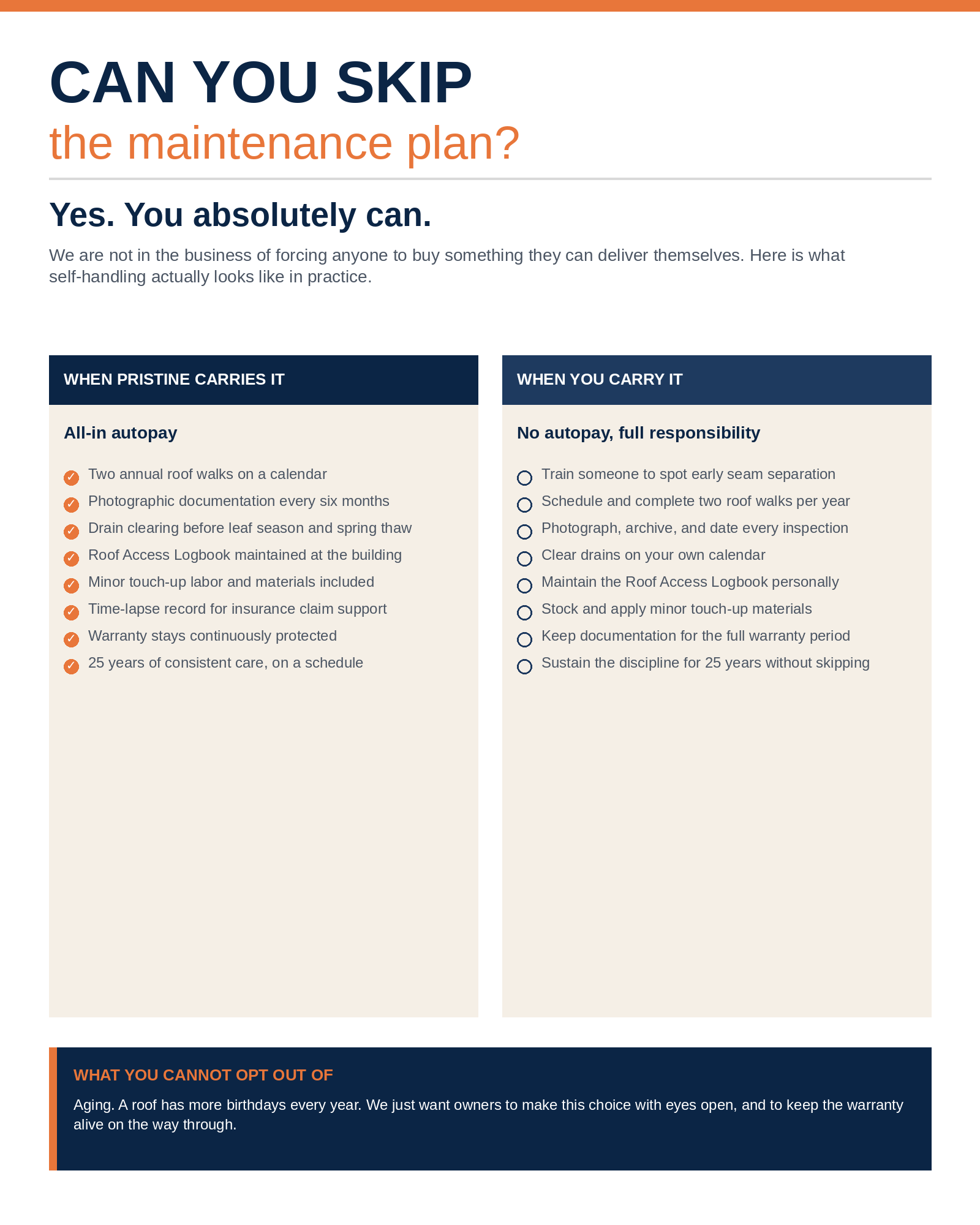
Yes. You absolutely can. This is the question owners ask most often, and the answer has not changed in twenty years of doing this work.
We are not in the business of forcing anyone to buy something they can deliver themselves. If you have an internal team that can carry the load, if you have a property manager with the right discipline, if you have a maintenance director who genuinely enjoys this work, we are not going to argue. Pull the plan out of the proposal and we will price the project without it.
If you can handle the full maintenance program yourself for less than the autopay number on the proposal, you should. We just want owners to make the choice with eyes open.
What The Maintenance Plan Actually Covers
When the autopay maintenance plan is active, Pristine carries the following load across the full warranty period:
- Two annual roof walks on a calendar, performed by trained crew.
- Photographic documentation every six months, archived to a shared folder.
- Drain clearing before leaf season and again before spring thaw.
- Roof Access Logbook maintained at the building, with every technician initialed in and out.
- Minor touch-up labor and materials included in the monthly rate.
- Time-lapse record of roof condition for insurance claim support if a named-peril event ever shows up.
- Continuous warranty protection: the manufacturer warranty stays alive because the inspection cadence is documented.
- Twenty-five years of consistent care on a schedule, with the same network, even if personnel changes.
What Self-Handling Requires
If an owner takes the maintenance plan off the proposal, the same work still has to happen. The work does not disappear. It just changes hands.
- Two roof walks per year, on a calendar, with somebody trained to spot early seam separation, ponding patterns, and flashing breakdown.
- Photographic documentation every six months, archived, retrievable, and dated.
- Drain clearing before leaf season and before spring thaw, with documentation of the work.
- A Roof Access Logbook maintained at the building, with every technician initialed in and out.
- Minor touch-up materials stocked on site and labor scheduled when inspections reveal them.
- Documentation kept for the full warranty period in a format the manufacturer will accept.
- The discipline to do all of the above for twenty-five years in a row, without skipping a year because the rest of life got busy.
It can be done. It has to be done correctly and continuously, or the warranty narrows. There are four levels of coverage in the manufacturer warranty, and an owner who opts out of professional maintenance opts down through those levels accordingly. That is not a Pristine rule. That is a Conklin rule, and every membrane manufacturer in the commercial roofing space has a version of it.
The One Thing You Cannot Opt Out Of
There is one party in this framework whose contribution is non-negotiable, and it is not on the list of five. It is time itself.
A roof is going to have more birthdays whether you celebrate them or not. We just have to save up for the birthday present.
Aging is what the maintenance plan addresses. The twice-yearly visits are not just observation walks. The crew is touching up. The crew is giving the membrane its necessary cosmetics. The crew is catching the small thing before it becomes the big thing. None of that work goes away when an owner self-handles. The cost simply moves from a predictable autopay line into the owner's own labor, materials, and calendar discipline.
If those line up, if the in-house team is real, the calendar is real, the discipline is real, and the documentation is real, then self-handling is a perfectly legitimate path. We have owners on both sides of that fence and we respect both decisions. Our only ask is that the decision gets made on the front end, with full understanding of the five-party framework, rather than discovered on the back end when a claim is filed and a gap shows up.
How To Use This Framework
Three concrete moves any commercial building owner can make this week, whether or not they ever work with Pristine:
- Start the logbook. A clipboard at the rooftop access point. Every third-party tech signs in and out. Cost: about four dollars.
- Send the one-time roof access agreement. Every recurring vendor, HVAC, hood cleaner, IT, satellite, cell tower, signs once, accepting responsibility for any damage their team causes during rooftop visits. Cost: an hour of admin time.
- Decide your maintenance posture. Either commit to the in-house cadence and document it relentlessly, or commit to a professional maintenance plan with a certified installer. The wrong choice is the half-commitment, where the work is intended but never actually performed.
That is the whole framework. Five parties, one logbook, one honest decision about who handles the maintenance. Get those three things right and the warranty stays alive, the insurance stays useful, and the roof reaches its full twenty-five-year service life on schedule.
PRISTINE INDUSTRIAL ROOFING
Conklin Certified Commercial Flat Roofing · Lake County and Porter County · FLEXION 2.0 Vinyl Membrane Specialists · 25 Years / 300 Months Coverage
Questions? We answer every one of them, even the ones nobody else wants to answer.