Your Last Roof Repair Might Have Used the Wrong Chemistry
Warning: If Your Commercial Flat Roof Was "Repaired" in the Last 3 Years, There's a Good Chance It Was Done With the Wrong Materials. Here's How to Tell. The repair looked fine. The invoice looked real. The chemistry was wrong. And your roof has been failing ever since.
🔲 Wrong material = guaranteed failure. Incompatible patches don’t bond, even if they look fine.
🔲 Most roof leaks repeat because contractors skip identifying membrane chemistry.
🔲 “Universal” sealants are a myth. Each roof type needs specific compatible products.
🔲 Bad repairs don’t just fail. They trap moisture and accelerate costly structural damage.
A Repair That Wasn't

A property manager in Hammond called us last Fall about a persistent leak over a storage area. She'd had it "fixed" twice in the past two years. Different contractors each time. Each one assured her the problem was solved.
It wasn't.
When we got on the roof, the issue was obvious within five minutes. The existing membrane was PVC, a vinyl-based system. The first contractor had patched it with a product designed for expired rubber EPDM. The second contractor had applied a silicone-based sealant on top of the first failed patch.
Neither product bonds to PVC. Not chemically. Not mechanically. Not temporarily. They sit on the surface like tape on a wet window. They look attached.
They're not.
Both repairs were destined to fail the day they were applied. The contractors didn't know. The property manager didn't know. And the invoices didn't mention membrane chemistry because the contractors never checked.
She paid twice for nothing. And the actual damage underneath had been getting worse for 24 months while everyone thought it was handled.
Why Chemistry Matters More Than Skill

Commercial roofing membranes are not interchangeable. They're built on distinct chemical platforms, and each platform has specific requirements for repair, coating, and adhesion.
Plastic wrap tPo is a thermoplastic polyolefin. PVC is polyvinyl chloride. Expired rubber EPDM is ethylene propylene diene monomer, a synthetic rubber. Modified bitumen is asphalt-based. Each one has a different molecular structure.
A sealant designed for rubber will not bond to vinyl. A coating formulated for asphalt will not adhere to plastic wrap tPo. A patch material engineered for one chemistry applied to another chemistry creates a temporary visual fix and a permanent structural problem.
This isn't about craftsmanship. A highly skilled roofer using the wrong product will produce the same result as an unskilled roofer using the wrong product. The chemistry doesn't care how carefully you apply it. If the molecular bond can't form, the repair can't hold.
How This Happens Every Day in Northwest Indiana
Here's the typical scenario. A building owner notices a leak. They call a general roofer or a handyman. That person goes to the nearest supply house and grabs whatever sealant or patch material is on the shelf. They apply it. The leak stops. Invoice sent. Done.
Nobody asked what membrane type is on the roof. Nobody checked the product's chemical compatibility. Nobody called the membrane manufacturer for their approved repair protocol.
It's not malice. It's ignorance. And it's the most common failure pattern on commercial roofs across Lake and Porter County.
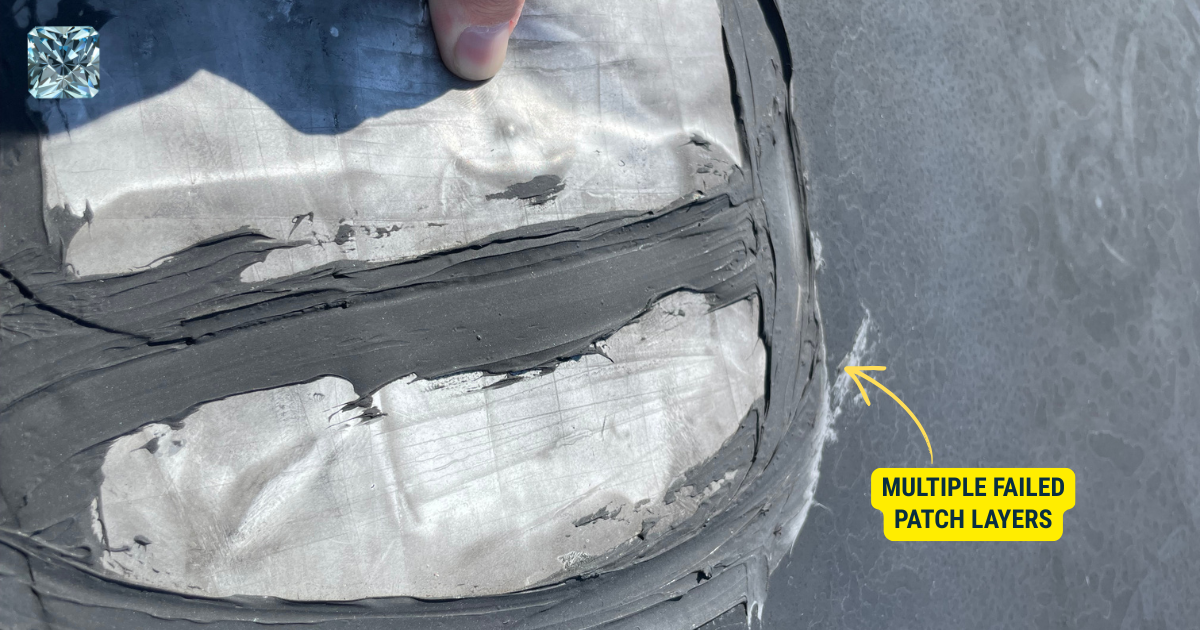
We've walked roofs in Merrillville with three layers of incompatible patches stacked on top of each other. Each one applied by a different contractor over a span of five years. Each one failed. Each one trapped moisture underneath. By the time the building owner finally called for a real evaluation, the insulation was saturated and the deck was compromised.
What started as a $3,000 repair was now a $45,000 conversation.
✉️ Is Your Last Repair Still Holding?
If your roof has been patched in the last few years and you're not sure the chemistry was right, now is the time to find out, not after the next rain.
Subject Property Address: ___________________________
FREE evaluation. No sales pitch. No pressure. No obligation.
[ Email address ] → [ Send Me the Real Stuff ]
How to Tell If Your Roof Has Incompatible Repairs

You don't need to be a chemist. You need to know what to look for.
If you can see patches on your roof that are a different color or texture than the surrounding membrane, that's a flag. If the edges of a patch are lifting, curling, or separating from the membrane surface, the bond is failing, likely because it never formed. If a repaired area is leaking again within 6 to 12 months of the repair, the chemistry was almost certainly wrong.
If a contractor applied a product and couldn't tell you the exact membrane type on your roof and why the product they used is compatible with it, the repair is suspect.
The right question to ask any roofer before they touch your building: "What membrane type is on my roof, and is the product you're using chemically compatible with it?"
If they can't answer that clearly, they shouldn't be on your roof.
What a Real Repair Looks Like
When we evaluate a commercial roof, the first thing we identify is the existing membrane chemistry. Not the color. Not the age. The chemistry.
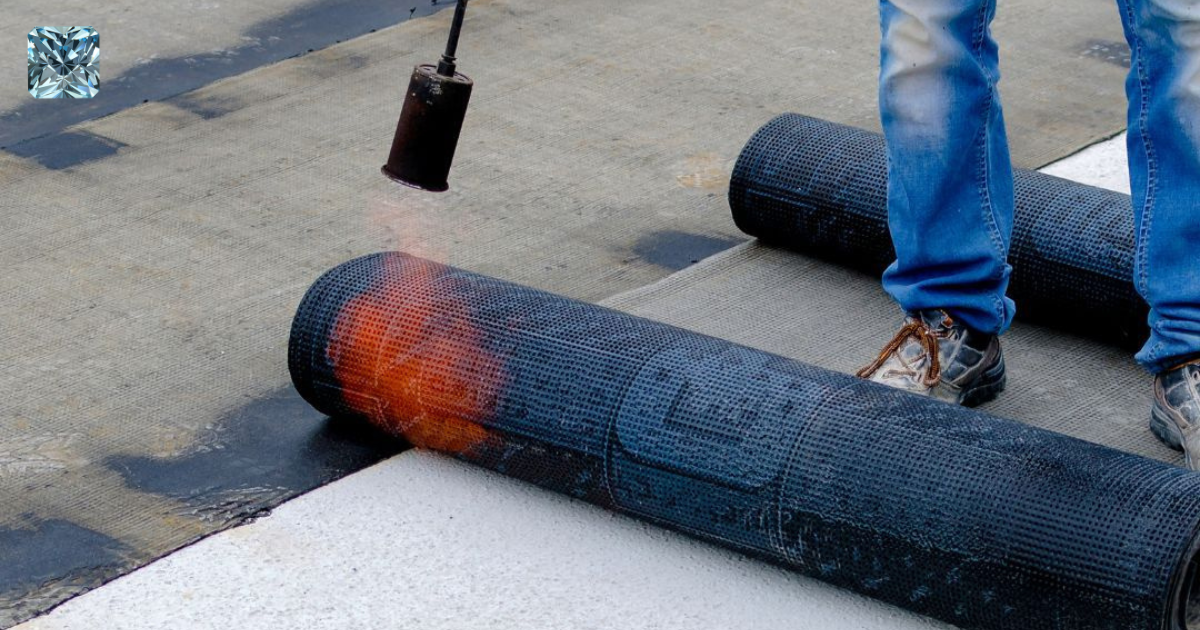
Once we know what we're working with, we select repair materials from the membrane manufacturer's approved product list. For PVC membranes, that means heat-welded patches using the same vinyl chemistry, the same approach built into every FLEXION vinyl 300 installation. For Conklin-coated systems, that means Conklin-approved products applied at the specified thickness and coverage rates.
Every seam, every patch, every linear foot of flashing bonds at the molecular level to the existing surface. No guessing. No grabbing whatever's on the shelf. No hoping it sticks.
This is the difference between a repair that lasts 6 weeks and a repair that lasts the life of the system. The skill matters. But the chemistry matters more.
Superior menu options exist.
Northwest Indiana Commercial Roof Chemistry FAQs
Can the wrong patch material damage my commercial roof? Yes. An incompatible patch doesn't just fail, it traps moisture underneath the repair, accelerating deterioration of the membrane and insulation below. Every failed patch that stays on the roof is actively making the problem worse.
How do I know what type of membrane is on my commercial roof? A professional evaluation will identify your membrane type. The four most common commercial membrane types in Northwest Indiana are plastic wrap tPo (thermoplastic polyolefin), PVC (polyvinyl chloride), expired rubber EPDM (synthetic rubber), and modified bitumen (asphalt-based). Each requires different repair chemistry.
My roofer said he used "universal" sealant. Is that safe? There is no universal sealant that bonds reliably to all commercial membrane types. Products marketed as universal may adhere temporarily but will not form the molecular bond required for a lasting repair on most membrane systems. Ask your contractor to confirm the specific product used and its manufacturer-documented compatibility with your membrane type.
Why did my roof repair fail within a year? The most common cause of early repair failure on commercial flat roofs in Northwest Indiana is chemical incompatibility between the repair material and the existing membrane. If the product can't form a molecular bond with the surface, it will separate. Rain, thermal cycling, and freeze-thaw cycles will accelerate the failure.
Can incompatible roof repairs void my warranty? Yes. Most commercial roof warranties require that all repairs be performed with manufacturer-approved materials applied according to the manufacturer's specifications. Applying an unapproved product to the membrane can compromise warranty coverage in the affected area, or in some cases, the entire roof system.
What makes Conklin-approved repair products different from off-the-shelf options? Conklin liquid-applied systems are formulated to bond chemically with Conklin-coated surfaces. Off-the-shelf sealants are not. When a Conklin-coated roof is repaired with Conklin-approved materials at the correct thickness and coverage rates, the repair becomes part of the system. When it's repaired with an incompatible product, you have two surfaces pretending to be one. They're not.
How does freeze-thaw cycling in Northwest Indiana affect incompatible repairs? Lake-effect moisture and 38 inches of annual precipitation give Northwest Indiana one of the more demanding freeze-thaw environments in the Midwest. Water that infiltrates beneath an incompatible patch expands when it freezes, forcing the patch further away from the membrane surface. Each cycle widens the gap. What looks like a minor edge lift in November is a full separation by March.
What is the difference between a FLEXION vinyl membrane and a PVC membrane repair? FLEXION vinyl 300 is a PVC-based membrane system, repairs are made with heat-welded vinyl patches that fuse to the existing sheet at the molecular level. This is not a peel-and-stick operation. The weld is permanent. A contractor who patches a PVC or FLEXION membrane with anything other than a heat-welded vinyl patch is applying the wrong chemistry. The repair will fail.

✉️ If your roof has been "repaired" in the last few years and you're not confident the chemistry was right, it's worth finding out.
Subject Property Address: ___________________________
Drop the address. We'll evaluate what's up there, identify any incompatible materials, and tell you exactly where the risks are, before they show up on a ceiling tile.
FREE evaluation. No sales pitch. No pressure. No obligation.
[ Email address ] → [ Send Me the Real Stuff ]
Pristine Industrial Roofing — Serving commercial and industrial property owners across Lake County and Porter County. Liquid-applied Conklin coating systems. FLEXION vinyl membranes. Proactive maintenance programs.